
How the Death Penalty Relies on a Culture of Violence
By: Bekky Baker, Program Director
Published 11/9/2026
The death penalty is in the headlines across the nation. The botched execution of Christa Pike. The call to perform a military execution on live television. Governor Gavin Newsom commuting the entirety of California’s death row, a quarter of the death row population across the whole country. In the midst of both these harrowing and celebratory moments, it appears that more and more people are pondering not only the efficacy of the death penalty but what it means for us as a society to carry out state-sanctioned death. These moments also showcase how interconnected the death penalty system is with the violence embedded in our culture.
There is a special sort of irony when you are aiming to punish an act of violence by announcing a livestream of a firing squad execution. The attempt to create a spectacle and entertainment out of someone’s death in the name of patriotism is grotesque. Concurrently, rushing someone to the hospital after two doses of a substance meant to stop their brain begs us to ask, “What are we doing?” The push for vengeance will always say more about us than it will about the person being executed.
But we could argue that Pete Hegseth’s call for a livestream military execution wasn’t really about executions at all. This announcement came at the same time as the anti-Muslim rhetoric swirling around New York City Mayor Mamdani and Michigan Senate candidate Abdul El-Sayed. It came at the same time this administration sent ICE agents to raid the home of Representative Ilhan Omar, and as current sitting congresspersons publicly stated, “Muslims don’t belong in American society,” or called for more Islamophobia. Authoritarians will create scapegoats and do their best to divide and conquer because it helps them keep their power. This is an especially heinous type of cultural violence that not only emboldens hate, but also feeds into the caste system of race and class in our society.
The death penalty in our country is inextricably linked to racial inequities and white supremacy. The modern-day death penalty is an extension of lynchings and racial terror. The echoes carry on today when boys like Nolan Welles do not receive justice. It is also evident in the disproportionate number of Black people on death row. People are more likely to receive a death sentence if the victim is white. So it is no surprise to see the death penalty weaponized against the Muslim community.
Yet, last week, the people said, “No more.” The people said, “We are pushing back.” Tired of war, tired of attack ads against vulnerable communities, tired of being unable to afford groceries –people came to the midterms to say, “We the people decide, not big money, and it’s time to end the corruption.” It is a moment of hope that we can hold onto as we prepare for the road ahead to get rid of what is not working and build new systems. We, the people, must call for what that will look like.
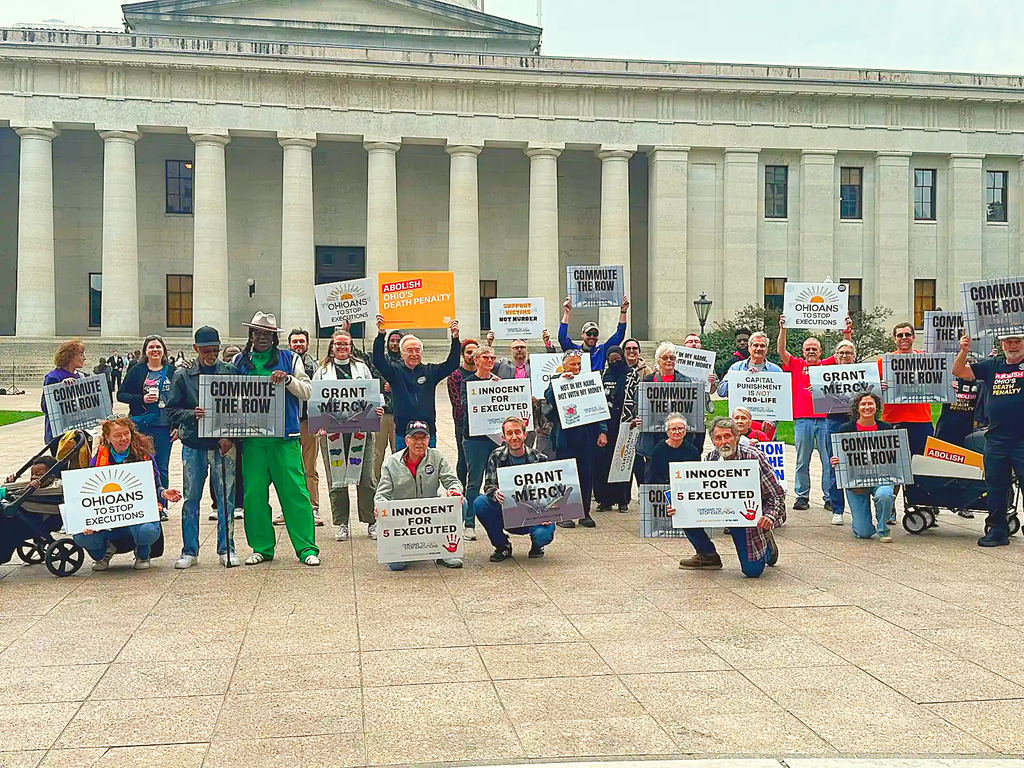
So here we sit, as Governor DeWine comes to the end of his term. He halted executions in Ohio for the last eight years and announced that he believes the death penalty is a broken and faulty system that does not deter crime. As he prepares to leave office, he has the opportunity to grant commutations for people on death row, just as Governor Newsom did. While it is not often mentioned in the news coverage, it is the years of organizing, conversations, education, and more that helped make that moment possible.
As people in our lives bring up questions about the death penalty, it is important that we help them connect these moments to the cultural and systemic violence that it upholds. To build the nonviolent communities that we want, we must understand not only the history of our society but the tendrils of historic violence that still shape our world and grip us today. It also requires imagination. Activists like Angela Davis and Eddie Ndopu remind us that we must be able to think outside of our current context and to believe that there is a different way of being.
As we head into the new year, a new Ohio legislative session, and a new formation of political leaders, the time to demand the world that we want is now.